
Railfan Vignettes of the
LIRR Special Services
.jpg)
.jpg) Parlor
car operations (heavyweight as well as light weight), bar car operations and
bar cart operations as well as the three (3) commissaries set up to stock
these operations (Penn Station under a set of platform stairs, Richmond Hill
Storage Yard and the east end of Jamaica station at street level next to the
elevators) all fell under the jurisdiction of Special Services, offices of
which were housed at the Richmond Hill Storage Yard.
Parlor
car operations (heavyweight as well as light weight), bar car operations and
bar cart operations as well as the three (3) commissaries set up to stock
these operations (Penn Station under a set of platform stairs, Richmond Hill
Storage Yard and the east end of Jamaica station at street level next to the
elevators) all fell under the jurisdiction of Special Services, offices of
which were housed at the Richmond Hill Storage Yard.
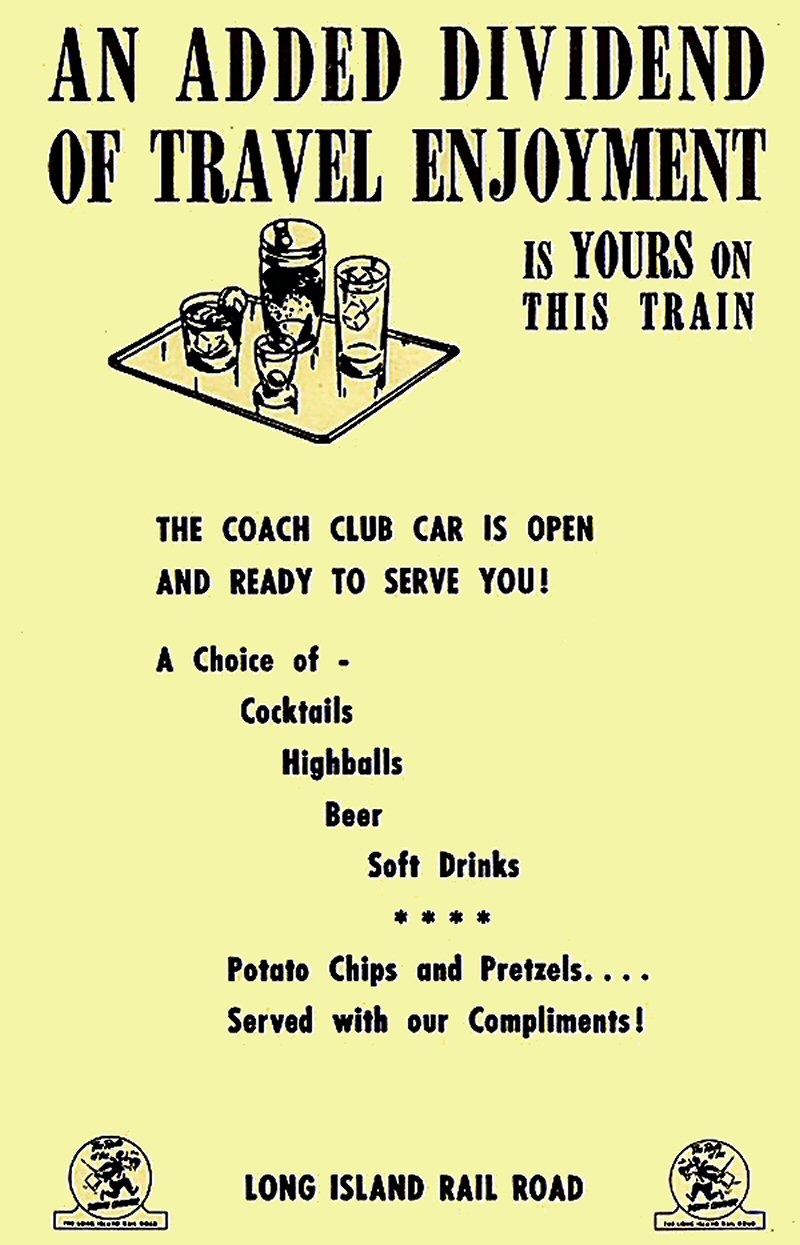
Special Services Parlor Car drink list order card: Archive: Dave Keller
1970's Special Services
 Back in the 1970s, The Long Island Rail Road had a summer program for
college students. You could either work during the summer as an extra
ticket clerk or as a Special Services Attendant. This was under the
assumption that you were to return to college in the fall. As a Special
Services Attendant, you worked the summer-only parlor car trains and filled
in as relief attendants on the bar cars and bar-carts used on commuter runs
for regular employees who were on vacation.
Back in the 1970s, The Long Island Rail Road had a summer program for
college students. You could either work during the summer as an extra
ticket clerk or as a Special Services Attendant. This was under the
assumption that you were to return to college in the fall. As a Special
Services Attendant, you worked the summer-only parlor car trains and filled
in as relief attendants on the bar cars and bar-carts used on commuter runs
for regular employees who were on vacation.
My first summer, 1972, was spent as an extra ticket clerk, but was not as much fun to me as riding the trains would have been, so, the following summer I opted for the Special Services Department in which I worked during my next 2 summers. This department was originally run by Walter McNamara, but was now under the control of Willie Wilson after Mr. McNamara’s retirement. Willie was an ex-Pullman Porter and one of the original members of the Special Services Department.
 As
a Special Services Attendant, I worked as a relief summer bartender on the
bar cars, manhandled the push-type bar-carts on commuter cars and worked as
an attendant/bartender/porter on the parlor car trains to Montauk and
(sometimes) to Greenport. This was also accompanied by stints working as
stock boy in the four commissaries: Jamaica, Richmond Hill, Long Island City
and Penn Station. These commissaries kept the bar cars, bar-carts and parlor
cars supplied with beverages and snacks. Photo courtesy of Paul Kennedy, Ronkonkoma c.
1975
As
a Special Services Attendant, I worked as a relief summer bartender on the
bar cars, manhandled the push-type bar-carts on commuter cars and worked as
an attendant/bartender/porter on the parlor car trains to Montauk and
(sometimes) to Greenport. This was also accompanied by stints working as
stock boy in the four commissaries: Jamaica, Richmond Hill, Long Island City
and Penn Station. These commissaries kept the bar cars, bar-carts and parlor
cars supplied with beverages and snacks. Photo courtesy of Paul Kennedy, Ronkonkoma c.
1975
After Ticket Clerk Basic Training, held in the former baggage room of the
Garden City station, everyone in the class was sent to a station to post. .
. on-the-job training as it were, under the regular clerk assigned to that
station. I posted at Farmingdale under Barbara Stillwagon. The first
day there, when we cut our cases and tallied everything up, she said "come
with me. You're my escort. We're headed to the bank." We rode to the
bank in her car, with me holding the night deposit bag.
I posted there for one week and during that time we chatted and she found out I was interested in the LIRR historically and that I collected LIRR items. After I left Farmingdale and went on the extra list, I got a call from her at the station I was working that day. She went out of her way to find out where I was working that day and called me to tell me the B&B department were doing some renovation work in the attic of the Farmingdale station and they came across a shit ton of freight receipts and record books from 1909-1910. Was I interested? She said she'd hold them for me in the ticket office.
I thanked her profusely and the next day I had off, I took the train from Ronkonkoma, got off at Farmingdale, took all the freight receipt books, and hung out at the ticket office until I was able to catch the next train back to Ronkonkoma, balancing all the items on the seat next to me.
Barbara's brother, also a Stillwagon, was clerk at the Long Beach station
at that time. He was kind of famous for giving CPR to a customer who
collapsed in the waiting room.
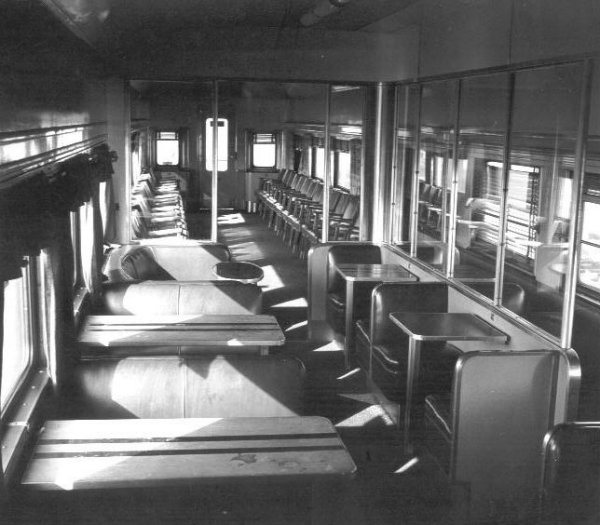 Closed end observation car “Asharoken” at Montauk 1974 Photo: Dave Keller |
 Lightweight parlor cars heading west from Montauk behind C420 #229. Engineer Tom Rome is highballing it through |
Another thing I didn’t much care for as a ticket clerk, was that I had to get to the railroad stations very early in the morning, usually prior to any trains providing service there. As a result, my employee pass served no purpose as I had to drive my car to the stations where I was assigned, unless I worked Jamaica or Pennsylvania Station.
As Special Services Attendant, I would be able to use my pass to take the LIRR into one of the four commissaries, and start my run.
Every day you had to call in to work or “shape up” as it was called, to see if there was any work for you the next day. If you were a good worker, and didn’t miss any time, you usually were assigned work regularly. If you missed a lot of time, the dispatcher would conveniently have no work for you that day.
 On one of those days, I was told to report to the Long Island City
commissary to pick up my train. I was to work as the second bartender
on a bar car which originated from the LIC yard, then ambled its way over to
nearby Hunterspoint Avenue, picked up passengers, and headed east. The
bar car to which I was assigned was scheduled to operate out to Montauk.
On one of those days, I was told to report to the Long Island City
commissary to pick up my train. I was to work as the second bartender
on a bar car which originated from the LIC yard, then ambled its way over to
nearby Hunterspoint Avenue, picked up passengers, and headed east. The
bar car to which I was assigned was scheduled to operate out to Montauk.
I was to report to the LIC commissary. Here I was to check in, get my car assignment, pick up my keys to the liquor locker on the bar car and go on board to check my inventory and count my stock. If I needed any more olives, maraschino cherries, lemons, limes, snacks, soda, beer or liquor I had to request the additional amounts from the commissary, then carry it to my car and load it up. Also necessary was enough ice for the trip. If you ran out of ice, you were dead in the water. No one would buy warm drinks. No drinks, no sales. No sales, no tips. (And you did pretty nicely on tips on these runs, I might add! One commuter run, on a bar-cart to Babylon, I worked an “off” night, when most of the commuters were on vacation and I raked in $60.00 in tips. Quite a haul for the early ‘70s when beer sold on the train for $.50 and mixed drinks for about $1.25!)
So, I did as I usually did. I took the train in to the commissary. Long Island City, however, was hard to get to by train. Driving was out of the question, as my father wouldn’t allow the car to be tied up for all those hours while I was on a run. I found it was easier to take the LIRR into Penn Station, take the subway shuttle to Grand Central Station, then the subway out to Queens and get off at the Vernon-Jackson stop. A short walk up the block from the station and I was at the LIC passenger yard.
I had done it many times before and it always worked out just fine.
Things, however, don’t always work out fine. This one time I was
delayed somehow. I can’t remember what happened, but the long and
short of it resulted in my getting to the commissary very late. My
train, I was told, had already left the yard and was headed towards
Hunterspoint Avenue. Wearing my uniform jacket, trainman’s hat with
“Special Services Attendant” badge affixed (more on that later), and
carrying my satchel with personal items, employee timetable and my
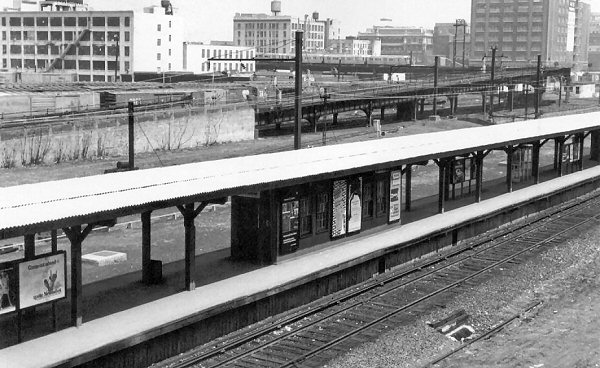
lunch/supper, I high-tailed it by foot after the train.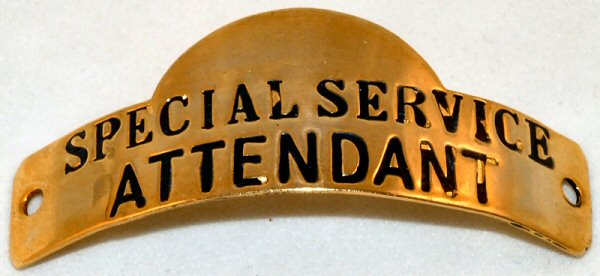
Let me tell you . . . it’s one heck of a trot from the LIC passenger yard to the Hunterspoint Avenue station, running between the rails, watching out for trains, carrying all your stuff and sweating up a storm in the heat of another wonderful Long Island August day!
So . . I got to the station platform, pulled myself up onto the train (traps were down on the non-platform side) and found the bar car. The head bartender and my supervisor had the liquor locker open and the bartender was counting the inventory and reading it off to my supervisor. When the supervisor saw me, he tore into me like there was no tomorrow! (Mind you, this was the first time something like this had ever happened in all my time spent on the LIRR.)
As the train was scheduled to pull out shortly, there was no time for me to re-count everything, so I was told to sign the inventory listing. As a stupid “kid” with no prior experience, I figured my boss wouldn’t “screw” me so I signed off on the list.
Well . . we worked our tails off on that train. Both the main bartender and I never stopped all the way out to the Hamptons. I was raking in tips like there was no tomorrow.
After that $60.00 commuter run, I figured I should be seeing $80- to $100 that night when all was said and done! When we got to Montauk, I counted down my liquor locker and figured the sales. When I counted my money, and figured what was owed the company I was left with $20.00 in tips.
It was then that I realized what had happened back at the start of my run and that the main bartender had cheated me out of my tips by fudging the figures and transferring liquor from my locker to his (next door to mine) which he obviously sold for full profit at my expense.
Never again did I ever sign for someone else counting my inventory and never again did I ever allow myself to arrive that late to a job.
We worked the newer, light-class fleet of parlor cars that arrived in recent years from other roads. I never worked an old heavyweight car. Some of the cars were fine, others were perpetually filthy (and we just recently acquired them!!). Some smelled really bad because each of the compartments had their own toilets and they were screwed shut and sealed, but were never pumped! I mentioned this one time to Willie Wilson about an exceptionally “ripe” roomette. He walked into the compartment, puffed his ever-present cigar a bunch of times in there, shut the door quickly, then said to me “that oughta be OK!”
It was 1973. I was working my first parlor car to Montauk. I had heard all the trainmen in the passenger cars hollering out stops. I'd ridden the LIRR for a number of years prior to working there and knew the routine.
"Westhampton . . .Westhampton. . .next stop, Quogue!"
So, I did the same in my parlor car. I walked down the aisle hollering "Southampton . . .Southampton . . next stop, Bridgehampton!"
The door to one of my compartments opened and out came Walter McNamara. I'd seen his photo enough times to recognize who he was.
"Hey, son" he said calmly and nicely. "The riders in this car don't need to be told what stops we're making. You know all their destinations. It's your job to knock on their doors and let them know that we're about to reach their stop and prepare to take their bags."
"Yes, sir . . thank you sir." I never called out another station stop. I liked my job and wanted to keep it.
As a result of my Long Island City “missed-train” experience I was assigned a parlor car out of the Richmond Hill Storage Yard and commissary and was determined to get there early. I got there hours ahead of time, found my car, stocked it up, then pulled a sleeping berth down and snoozed. There was no power in the car, so I died in the heat. I was stripped to my underwear and tried to get some shut-eye. I must have fallen asleep, because the next thing I know, I’m freezing to death, as the car electrician had walked through and put the power on some time earlier and all my sweat chilled me. I got a nice summer-type cold as a result of that experience.
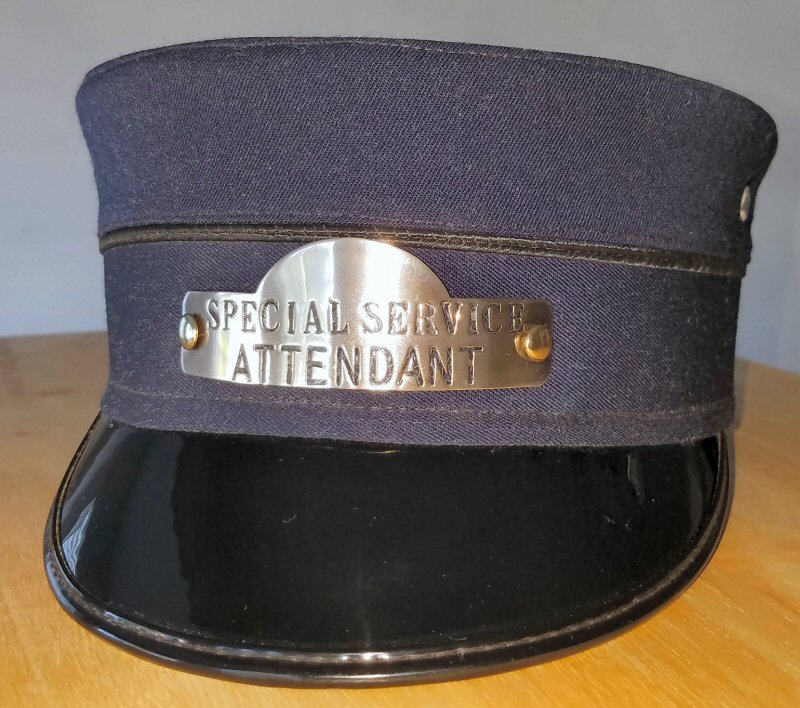
As for my earlier mention of the “Special Services Attendant” cap badge, these badges were worn along with the gray trainman’s uniform in the early days of the Special Services Department (early 1960s). Over the years, it was determined that the men didn’t have a need for regular uniforms as such, so they had to provide their own black pants, black shoes, white shirt and the company provided a ratty, blue, 2-buttoned cotton jacket with NO IDENTIFICATION whatsoever of the railroad affixed thereon.
When we worked the parlor car trains out to the Hamptons and Montauk, as well as to Greenport, part of our job and tip income came from carrying the luggage both on and off the train for the passengers. When they got off the train, you only carried for your own car’s passengers, but when they were boarding, the passengers of the entire train were fair game to all interested porters. A lot of the summer guys felt it was beneath them to carry bags so refused to make the effort. These same guys used to bitch and moan that they never made any tips. Go figure! Poor babies!
Well, we all know how suspicious New Yorkers are about strangers approaching them. Well, here’s a passenger loaded down with baggage, and some young guy walks up to them without any identifying markings on his clothing that show he works for the Long Island Rail Road, and attempts to take their baggage from them.
This didn’t go over well in many instances. There were a number of arguments and disagreements.
There was one old timer who worked in the department and was a former Pullman Porter. He worked for the LIRR as an attendant for many years. He still wore the gray uniform and the trainman’s hat with “Special Services Attendant” badge. He got ALL the tips. He carried ALL the bags he ever needed to carry. People walked up to him and handed him their bags without asking.
I asked him where he got the badge and he referred me to Willie Wilson. I went to see Willie and he gave me a badge. My good friend Jeff Skinner, a retired LIRR conductor and contributor to the railroad’s employee newsletter “Metrolines” (he wrote the retirees’ column), managed to finagle me one of the new, blue hats that were just coming into use.
Well, I have to tell you. . . I got a lot of laughs and ridicule from my peers, but what did I care? I was a railfan, I was proud to wear the cap, I was happy as a pig in you-know-what, just to be working on the railroad, and I got a huge increase of tips. People saw the LIRR hat, and immediately allowed me to carry their bags, no questions asked.
I primarily worked the parlor cars, which I preferred, because even though the tips weren’t as good as the commuter runs, you felt like a Pullman Porter. You got to work an entire car yourself and you got to take those nice, long rides to the eastern end of LI, either serving drinks in the early evening or serving coffee on the way back in on the early morning runs westbound. There was nothing like leaning out the vestibule Dutch doors, lower half closed, top half open, getting the wind in your face, smelling the diesel exhaust and looking at the scenery pass you by. (And ducking the occasional rock thrown at you!)
If you worked a train out of LIC or Richmond Hill, it was primarily parlor car or bar car service. If you worked a train out of Jamaica or Penn Station, it was bar-cart service.
On occasion I drew a bar car, which was kind of OK to work, as you weren’t limited to your movement, but you didn’t get to see much scenery and it was very smokey. What really was lousy, but made lots of tips, were the bar-carts. These stainless steel, wheeled contraptions held several bags of ice, several cases of beer, several cases of soda, lots of little individual bottles of liquor, plus snacks, lemons, limes, olives and cherries. Fill one of those things up and you had one heck of a cart to push!
After you filled your cart up at the commissary, you then had to get it to the train. If you worked out of Jamaica, the commissary was on the east side of Sutphin Boulevard, below the platforms and alongside the street itself. You rolled your cart to the individual freight elevators that are visible at the eastern end of the Jamaica platforms, took the elevators to platform level, then pushed them along the platform and waited for your train.
When the train arrived, (M1 electrics) you had to push your cart onto the car amongst all the commuters trying to get on, shove it into the corner to the inside of the double doors vestibule where there was the half-wide seat facing the full width seat, tie it off to a seat stanchion, and the vertical vestibule pole and start selling. You immediately had a line as soon as you entered the train. The regular commuters were OK. They knew you had to lash the thing down and set up. The occasional riders were the ones who gave you grief because you weren’t serving them fast enough.
If you got your train out of Jamaica, you were OK. Penn Station was not so easy. The commissary was located under the stairway accessing one of the LIRR platforms. After you filled your bar-cart, you then had to proceed down to the western-most end of the platform and take one of the steam-powered freight elevators that went down to the “catacombs” of Penn Station. There was a crossover tunnel down there that accessed all the platforms. You then took a steam-powered elevator up to your platform.
In theory this should work fine, however . . . There were water bugs down there that would put Florida bugs to shame! (Not to mention the rats!). And, for good measure, on hot summer days when the draw on power was great, Con Edison would cut off steam power first, before cutting back on electricity. If you were one of the lucky guys down in the “catacombs” when they cut steam power off, you were stranded down there. Then, if and when the power was cut off, your lights went, too.
There was a story of one attendant who got himself trapped down there. He finally made his way up an escape ladder and popped a manhole cover off in the middle of the street by the U.S. Post Office facility behind Penn Station.
Another alternative was to find out from the dispatcher what train westbound into the yard, leaving your platform, became YOUR train eastbound out of the yard. Then, you simply keyed your doors open with your “moon key” I believe it was called, and rolled your cart onto the empty train. You rode it into the yard, then rode it back out onto your assigned track. Piece of cake.
Except when you got the wrong information from the dispatcher, or there was a last-minute change of equipment.
I spent the night with my cart, in the yard, in a dark car, because of one such case of mis-information. There was no way to lock the cart up and I wasn’t about to leave it unattended with hundreds of dollars of stock in it!!
I remember one trip I was to work a Port Washington train, but was told I must get off at Auburndale (high level platforms) and catch the next westbound train to Penn Station to return. This I did, but no one told me that I would be standing alone, in the nighttime, on an empty, lit platform, a spotlighted sitting-duck, all alone, waiting for the next westbound train or gang of punks to come along. And me with all that cash from a good commuter run!!! That night I was lucky. (More: see following section below)
Another time, I was working a bar car to Montauk and the air conditioning was not working in the car. Everyone was dying of the heat. I had a bottle of seltzer sitting on top of the bar and it kept shaking and shaking and shaking with the movement of the train. That, in conjunction with the extreme heat of the car (I guess) caused it to suddenly explode, cutting a young lady like flying shrapnel. She wasn’t hurt badly, but it really could have been worse!
Me and another bartender worked a bar car to Speonk. The head bartender, an old-timer, was well experienced in this run, and had us begin closing up shop after Patchogue. The idea was to start counting everything down and locking up so we could jump off the train at Mastic-Shirley and take the Road-n-Rail bus (which stopped on Montauk Highway about in line with the depot) back to Patchogue where we picked up a train. The alternative was a several hour wait at lonely Speonk at night for the next westbound train. That was an experience. It went well and he was a big help but I found that the Road-n-Rail bus DID NOT honor your employee pass, so I had to pay the fare.
Once, we had finished our run to Montauk and were deadheading an equipment train back to Jamaica. The entire train was dark and carried only the returning crews. This was my first dead-head run, so I got into the dark, last car of the train and snoozed. All the others were in the lighted head car, talking, drinking, smoking and playing cards.
Well . . we approached Jamaica. My clue was the rough crossovers at Union Hall Street which would always wake me up and advise me we were getting close. I gathered my bag, opened the side door and waited for the station stop. I was told that the train would make an employee stop at Jamaica for us to get off.
We stopped all right. The engineer spotted the head car at the very eastern-most edge of the Jamaica platform and I watched everybody exit the head vestibule. This was about a 15-car train and there was no way in hell I could run from the rear car to the head car in time. I started to run to get closer, but didn’t make it. The train started to move and I had this wonderful feeling of spending the night in the LIC passenger yard. The train began to pick up speed, so I chose a door and opened it. By the time my door was at the platform the train was making good speed. I took a breath, leaned in the direction opposite of my movement and hit the platform running. I swear to this day, I must have run ¾ of the Jamaica station platform before I could stop. But I never tripped and fell!!
On the next dead-head run, I was up front in the head car watching the guys play cards, smoke and drink beer.
There were three ways to get to the Richmond Hill storage yard and commissary from the Jamaica station. One was to walk along Jamaica Avenue and risk being mugged. Another was to walk to the western-most end of the Jamaica station platform at track 8, go down the steps and walk between the electrified tracks, over the Van Wyck Expressway overpass, pass the old freight/express/mail building, the old Richmond Hill turntable and the trainmen’s building with cupola tower, then onto the commissary. Believe it or not, this was a rather quick route and very safe if you were careful. And you could do it at night without getting attacked!!
The other way was to get on a Flatbush Avenue-bound train, ask the conductor to advise the motorman to make an employee stop at Morris Park Shops, then, key the door open and get out on the tiny one-door-wide steel platform there. Then, walk around the blacksmith shop, past the diner, and up the north-south road that ran between the facility’s fence and the first set of car repair buildings. You would wind you way along, cross under the Montauk branch and . . voila . . you were in the Richmond Hill Storage Yard.
On one such jaunt, I got on the Flatbush Avenue train, asked the conductor to make the stop at Morris Park Shops and he said OK. By the time we reached Morris Park, we were going much too fast for a stop. I ran up to the conductor who said “Oops, I forgot to tell the motorman!” Well . . I got off at Woodhaven (which was still a stop at the time), crossed over, and waited for an eastbound train back.
Lots of fun. Lots of lousy stuff (like the rotten supervisor or the mile-long walk into Montauk Village to get something to eat, then the mile-long walk back to the yard!!!), but lots of good memories that I wouldn’t give up for anything!
 So . . . I
was assigned a bar cart on a Port Washington run. I was told that most of
the heavy drinking (all the big sales) was done by the time the train
reached Auburndale. After that, your sales were hit-and-miss.
So . . . I
was assigned a bar cart on a Port Washington run. I was told that most of
the heavy drinking (all the big sales) was done by the time the train
reached Auburndale. After that, your sales were hit-and-miss.
If I stayed on the train to Port Washington, I'd have to wait hours until the next westbound headed back, so it was advised that I wrap up quickly and get off at Auburndale. That way, it was only a short wait for the next westbound to take me back to the Penn Station commissary.
I'm all wrapped up. I've untied my bar cart from the vestibule support posts and have the cart rolled out into the vestibule of the M1. The train makes the station stop and I get off at Auburndale, only to find that now it's dusk and I'm the ONLY ONE standing on the entire station platform which was poorly lit. I'm a visible target with booze, beer, and all my cash and the neighborhood was pretty bad around the station then . . . I can imagine how much worse it is today!
I have to say I breathed a sigh of relief and a "thank you LORD!" when the westbound made the station stop and I loaded old Betsy on board!!!
I vowed that if I ever was assigned that trip again, I'd work it to Port Wash and just wait around. At least I could wait in the depot with personnel around. But had I done that, I'd have more problems as the commissary would be closed by the time I got back and I'd be sitting with the cart on the Penn Station platform until morning. I luckily never got assigned another Port Wash train.
A similar situation was when I worked the bar car to Speonk. If you got off at Speonk, where your train terminated, you waited a few hours for the next train west, having passed the earlier westbound as you were headed east. So it was suggested by the senior bar man we get off at Mastic-Shirley, which we did. The westbound train still ran ahead of us, so we walked the 2 blocks to Montauk Highway, carrying our cash (booze, etc. were locked up on board the bar car) and sat on a bus bench as visible targets until we caught the westbound Road n' Rail bus to Patchogue. The senior guy took the train from Patchogue to wherever he got off and I got off and headed home after my father picked me up at the station. I waited safely in the trainmen's room in the station. Luckily the only problem we faced at Mastic-Shirley was finding out the Road n' Rail bus didn't honor LIRR passes, so we had to shell out the fare which was not refundable.
I never got assigned another Speonk run after that, either . . .thank GOD! Montauk runs only in Bar car/Parlor service and Babylon branch runs in bar cart service.
BAR CARS
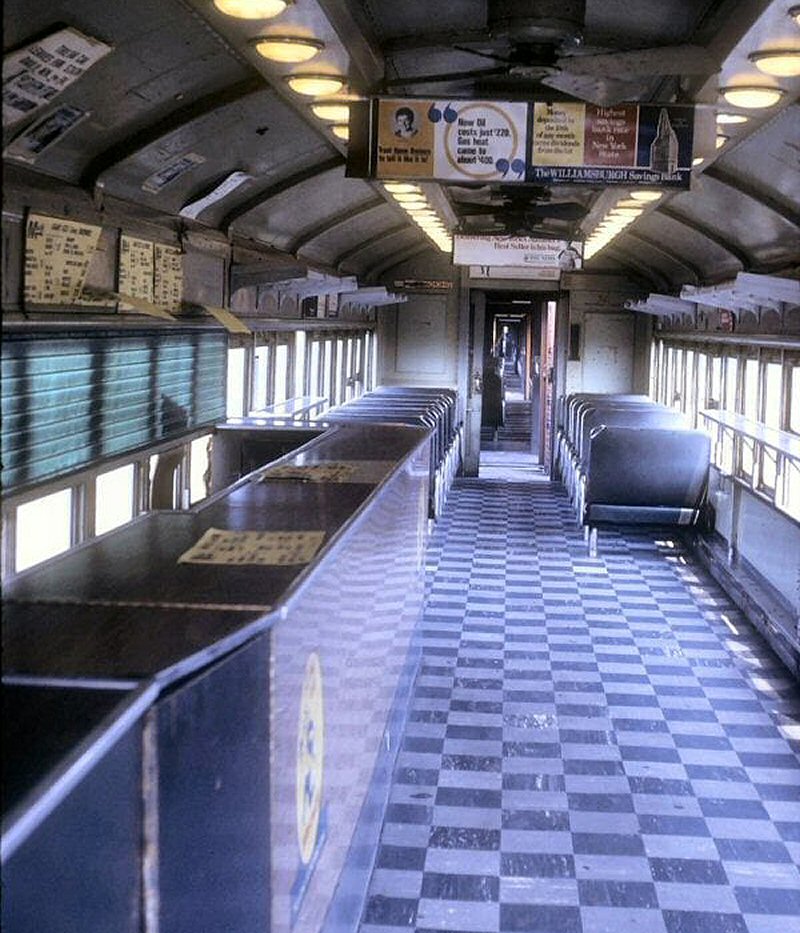 LIRR
#6508 Bar Car 8/1970 Photo: Art Huneke Archive: Douglas Nash
LIRR
#6508 Bar Car 8/1970 Photo: Art Huneke Archive: Douglas Nash
I worked Special Services LIRR in 1971 and 1972, and my first job in 1970 was with the Engineering Dept on the M-1s. The car in the picture, #6508 was a "one of a kind". It was an MU car, and the first rebuilds to coach bar cars DID HAVE about 1/2 the car with seats and a 1/2 length bar counter. This included 6508 and the there ex-BAR cars (8551-8553) When the "concept" took off, later cars (primarily the B&M cars had a longer bar) seating was reduced greatly to around 20 with many just having 4 seats at the ends bulkhead opposite the bar end. The 1677, last of the "Club" cars also "bought it" in May 1971 when the attendant almost had a "conflagration" in the service area using a burner to make morning coffee....by the next year, all coffee service ceased on morning trains...expense was the factor, and most commuters brought their own on the way to stations....did not generate enough revenue to justify the expense of the attendant plus many were older men who wanted to be home with their families, not sleeping out at some east LI point...they did enough of that in their Pullman Co. days. The 4 diesel hauled Club cars also followed 1677 in 1971 to oblivion due to the age and Clubs not wanting to pay the rising cost of operation.
The 6508 was pulled in May of 1971 as it was a month before I started, I never worked the car. There were sufficient number of M-1s accepted for service by then, it caused the massive withdrawal of MP-54 classes......and since 6508 was a T-54...trailers were a bigger operating headache. There were not yet enough reliable or delivered M-1s yet to let them do a thing about the newer MP-72 cars. This did not come about until the mid-70's when the new engines allowed the start of the push-pull era.
As for the changing MU fleet, this let the Spec. Svcs department go to wheel-on push carts rather than stationary bar cars like the New Haven M-2s. CONDOT commuters demanded them, NY commuters were so pissed with the LI's bad service at that point, they were thought frivolous and would not allow them. The push carts allowed flexibility for an attendant to cover multiple runs by working part of the trains distance then turning back on another to make 2 or 3 more eastbound trips.....a dedicated car would not allow that on the short electric zone runs. The push carts fit easier in the 3-2 seating bay by the door so were easier to set-up and work. Besides depending on operating conditions, since M-1s were high-level only, they could jump on or off at any station as conditions changed. Bars worked fine with the diesel trains still, as most runs, you were "in for the long haul" and required TWO attendants to work one of those long bars...........but one man would only work half way and double back the same night while the other took it to the end of the run, but with naturally declining passenger load.
As the railroad converted to push-pull (I was working full time at another railroad by then) the 7500 B&M bar cars of course fell to withdrawal in mid-1970s. There was no ability to replace the bar service, since many non-electric stations were still low level, so a push cart would not work...and passenger mentality was beginning to change, where people were into the MADD, and drunk driving campaigns, so the bar cars getting commuters soused on a 2 hr train ride did not go well with many communities have the same people trying to get to their home in suburbia. The 4 Bar-generators were an unmitigated failure and never caught on, as technology to put HEP in locomotives had advanced significantly with roads like Amtrak, MBTA, METRA, etc...........doing away with "power packs" and those cars...........and I don't think LI ever gave any thought to the one potential danger of them............you had passengers in a car with a diesel power plant...read: fire hazard
As the mentality of the MTA later changed, the remaining push carts and attendants were also phased out when M-7's took over....push carts were changed to "working a platform sales" in Terminals like Penn Sta, Brooklyn and maybe Hunterspoint instead of "roving" and with the now bi-level fleet, even parlor car service (THE reason for the Special Svcs Dept being created) also ceased, so the department was a couple of years ago shut down, of course it's "leaders" that gave it the initiative and force when I worked there had retired and passed away also. The department was seen by the MTA as an "unnecessary expense", though in it's hey-day it was a significant revenue generator (maybe the bar generators caused THAT??
In the push-pull era, there was a full bar car 2833 converted for use on most likely the "revived" push-Pull Cannonball train when the LI tried to revive and take back it's East End trade from things like the Hampton Jitney and the "wheezy dusty" milk stop service in the non-electric zone.
With the bi-level diesel trains, they retired the push-pull cars, both 2000 series parlors and the 2833............but since they required hi-level stations also, there saw a revival of a push cart bar service, but for parlor passengers, for a few years (just terminated in 2018) on the "Cannonball-era 4.......when LIRR took 2 of the bi-levels and sold them as "Hamptons Reserve" accommodations...........I had the chance of recreating something I had done 41 years earlier at the start of my railroading when I retired from my last job on Labor Day 2013 weekend............I deadheaded out to Montauk to ride their "Hamptons Reserve" so-called parlor car service on the "Cannonball", something I had worked back then in 1971, but it was all Pullman cars and called the Sundowner still. Douglas Nash
All the bar cars I ever worked were the converted B&M cars. The bar ran nearly the full-length of the cars. Locker at one end in which the liquor stock, beer and snacks were kept.
NO seats if
I recall correctly (S.R.O.) and poles with little round trays around them.
The trays were to rest drinks on and the poles were to hang onto after
you've had too many drinks! And were those cars PACKED like sardines!
And there
were quite a few lushes that I served . . but they were VERY good tippers.
One night in
a bar car, and an off-night at that (the regular car attendants timed their
vacations to the slow period of liquor sales so they wouldn't be missing too
much in tips), I earned $60 in tips . .. This was 1973 or 1974 and beer was
$.50 and mixed drinks $1.25 . . . so you can see how generous most people
were. And you see how many drinks got served . . and I was one of two
bartenders!
I remember
one extremely hot day (the cars were not air-conditioned) I had a quart
bottle of tonic water on the bar top. This was back when the bottles
were glass. Well that bottle was shaking and shaking and shaking with
the movement of the train and, combined with the intense heat, exploded atop
the bar sending glass shrapnel everywhere.
I'd never
ever seen anything like that before or since AND . . . praise God . . .
NOBODY was hurt whatsoever!
I have to say . . the job may have sucked but it was an outstanding experience for a young guy!
WORKING THE BAR CARTS
 Yes, I
worked the bar carts and what a hump-breaking experience THAT was!
Yes, I
worked the bar carts and what a hump-breaking experience THAT was!
First of
all, we were NOT allowed to sell on any platform. With that said, many
of the regular guys (not extras like us summer help) sold on the platform
and took the chance of getting caught. I never attempted that.
Didn't want to lose my railroad job. It was hard enough to get in the
first place! They wanted to make extra tips from riders who weren't
going on a train that had cart service.
We'd set the
cart up in the M1 cars in the immediate seat inside the center doors.
There was one short seat against the plexiglass divider and one long seat,
both facing each other. The cart would be set into that offset and
tied off onto the pole supporting the plexiglass divider.
Many
regulars knew that was where the cart would be set up and they'd actually
hold the seat for you, chasing others away who tried to sit there! I
thought that was kind of neat.
The
stainless steel cart was a bear. You loaded several cases of beer, a
case of soda, numerous boxes of single-serving liquor bottles, jars of
olives, fresh lemons, fresh limes, a bunch of snack packages and several
bags of ice.
Try moving
THAT around!
You'd try to
take advantage of other trains at terminals, for example in Penn station, if
your train was on, say, track 17 and you were on track 19 and a train
arrived on track 18, you'd try to push your cart through the train that was
between where you were standing and where you had to be.
Many times
it didn't work that way and you had to use the elevators. Jamaica had
elevators at the east end of each platform with a street-level passage under
all the tracks. That wasn't too bad, as the commissary was there under
the tracks as well. Penn station, on the other hand, had steam-powered
elevators at the west end of each platform which went down to an even
further subterranean level passage under the tracks. This was
originally for the use of transporting the U. S. Mail from the terminal to
the GPO behind it. It was loaded with rats the size of cats and water
bugs the size of coffee cups. You did NOT want to go down there if you
had any choice and you also faced the problem of getting stuck down there.
As these
elevators were steam-powered, Con Ed would cut the steam power before
cutting the electrical power during heavy summer usage so if you were down
there when the steam was cut, you were stranded indefinitely. Then,
when they cut the electricity, you were in the dungeon . . . . I knew
one attendant who got caught down there in the dark and was down there for
hours while he felt his way along the slimy walls and fortunately located a
ladder which took him up through a manhole cover into the middle of the
street between the terminal and the GPO!!!
Another way
to get your cart to another track was to ask the usher if the train on your
platform was heading into the yard behind the terminal and coming out as the
train you've been assigned to work. So if you had to serve on, say,
train 24 eastbound, and you found out that the train on your platform was
train 23 westbound and that it was going into the yard and coming back out
as train 24, then you got on train 23, rode into the yard and set up your
cart. Then your train came back out as train 24 on some other platform
and you were ready to serve the boarding passengers!
I tried this
once . . . and got stranded in the yard because there was either a change of
scheduled trains or the usher was screwing around with me. I couldn't
get off the train because that would mean leaving all that beer and liquor
unattended and I'd be responsible for anything missing (stolen). So I
just stayed put and hoped the train wasn't scheduled to go out the next
morning. Luckily it went out sometime later and I still managed to
make my run. I never did that again and used the steam elevators as
necessary, taking my chances.
You also had
to start packing up your cart some stops before you got to your terminal so
you had a chance to get out and catch the next train back. Sometimes,
you had to jump ship early so as to get the train back to Jamaica, or Penn
Station and not have to wait 4 hours at the terminal for the next train
back, by which time the commissary was closed and you had to stay with your
cart, unattended, until the commissary opened the next day! Jamaica
station and/or Penn station got quite empty of people after 11:00 pm. . . .
I worked a
Port Washington train once. I had to get off at Auburndale, so as to
catch the westbound from Port Wash back to Penn Station. Auburndale at
that time was a slum ghetto and I'm standing completely alone on the
elevated platform in full view of any potential mugger, with a cart loaded
with beer and liquor and me carrying the run's cash receipts, no other
passengers around, evening beginning to get darker by the minute, waiting
for that westbound to arrive. I made it back safely, praise God!
Another time
I worked a bar car to Speonk with a regular attendant. We locked up
our stock after leaving Patchogue, then jumped ship at Mastic-Shirley,
walked from the station to Montauk Hwy, carrying our cash and sitting on a
bus stop bench, waiting to take the LIRR's Road n' Rail bus back to Babylon.
The bus did NOT accept our employee passes so we had to pay a fare.
The alternative was to get to Speonk and sit there for 3 hours for the next
westbound.
During 1973 and 1974, we sold Budweiser and Schaefer with Michelob as the "higher end" choice. Bud and Schaefer were $ .50. I don't recall the price of Michelob. . . Maybe $.85. . . but I never sold much of it and tips were better on the other 2. Many patrons would give you a buck and say keep the change. So you made $ .50 on each beer. Most would give you a quarter tip on each beer. With Michelob you only made $ .15, so none of the bar guys pushed that item.